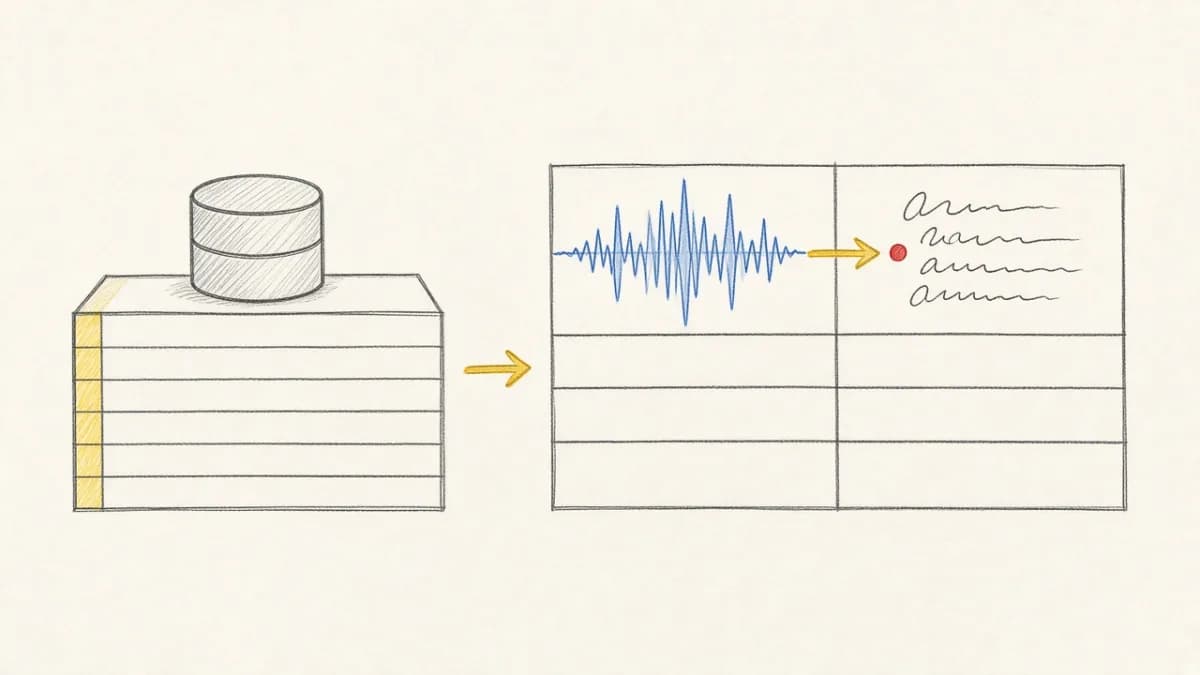
The Multimodal Challenge: Beyond Simple Data Types#
Modern AI applications increasingly need to understand and process multiple types of data simultaneously – text, images, video clips, audio streams, PDFs, and more. Building systems that can seamlessly ingest, process, relate, and query across these modalities is complex. Traditional approaches often require stitching together numerous specialized tools, leading to brittle pipelines, data silos, and significant engineering overhead.
The Pixeltable Solution: Unified & Declarative Infrastructure#
Pixeltable provides a unified, declarative data infrastructure designed specifically for the AI era. Instead of complex orchestration scripts, you define your data structures and processing logic using familiar table and view concepts, letting Pixeltable handle the underlying complexity of managing diverse data types, incremental updates, and data lineage.
Example: Unified Table & Cross-Modal Processing#
Imagine needing to process videos, extract audio, transcribe it, and then index the transcriptions for search. Here's how Pixeltable streamlines this:
This entire pipeline, from video/audio ingestion to searchable transcript embeddings, is defined declaratively. Pixeltable manages the execution, dependencies, incremental updates, and lineage automatically.
Example: Indexing & Search on Processed Data#
To make the transcribed text searchable, we can create a view to split it into sentences and then add an embedding index:
Key Feature: Unified Data Management#
Stop juggling separate systems for different data types. Pixeltable provides a single, consistent table interface where video, audio, images, documents, and structured metadata coexist. This simplifies data loading, querying, and relationship management across modalities.
Key Feature: Cross-Modal Processing & Search#
Apply functions that bridge modalities. Extract audio from video, generate text descriptions from images, or search across different types using multimodal embedding models like CLIP.
Key Feature: Advanced Search & RAG#
Pixeltable makes building sophisticated RAG context retrieval straightforward. You can define reusable query functions that encapsulate your retrieval logic, which can then be applied automatically as computed columns.
Imagine a messages_view containing chat history with embeddings. You can define a query to find relevant context for new questions:
This declarative approach for RAG context retrieval offers several advantages:
- Retrieval logic is encapsulated and reusable.
- Context retrieval runs automatically for new questions.
- Results (the retrieved context) are stored and versioned alongside the questions.
- The entire process is incremental and benefits from lineage tracking.
This is significantly cleaner and more maintainable than manual pipeline orchestration for RAG.
Getting Started#
Ready to start building? Try our hands-on tutorial: Build a Smart Image Organizer in 10 Minutes for a practical introduction, or create a basic multimodal table yourself:
Conclusion: Focus on Innovation, Not Infrastructure#
Building multimodal AI applications doesn't have to mean wrestling with a complex web of specialized tools and fragile integration code. Pixeltable provides the unified, declarative data infrastructure needed for the AI era, allowing you to focus on creating innovative applications while Pixeltable handles the underlying complexity.