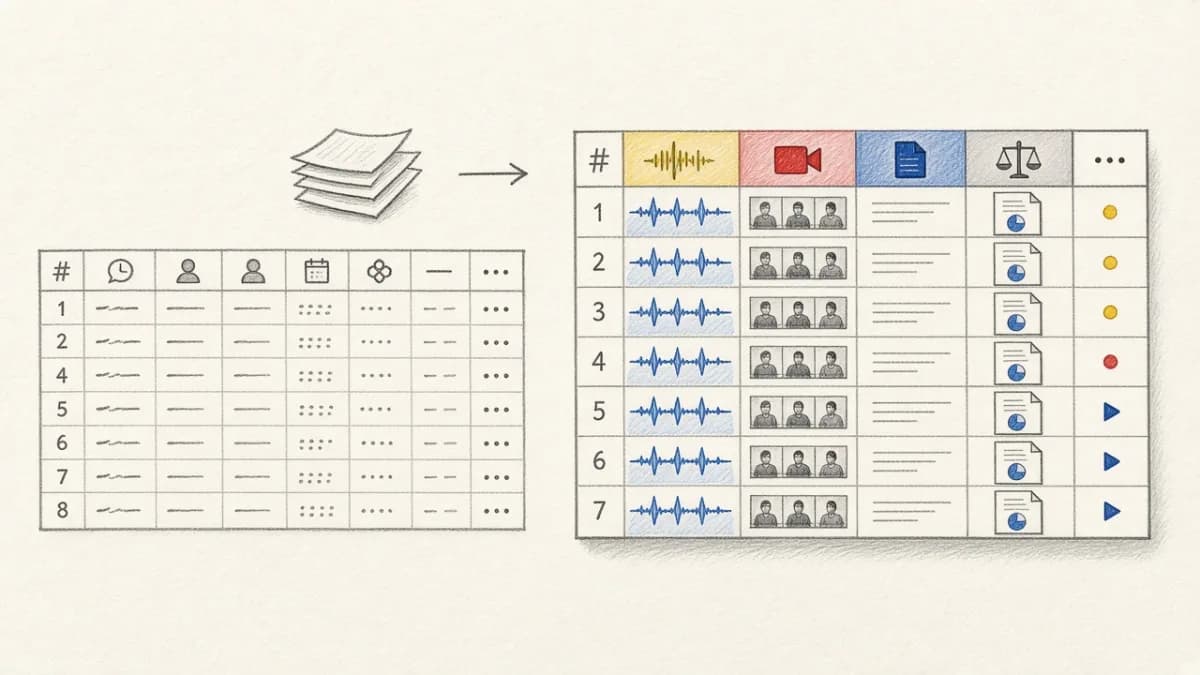
Pixeltable is designed to simplify working with multimodal data for AI applications. Its core principle is to provide a declarative and incremental data processing framework. Instead of manually building complex pipelines to handle data loading, transformation, model inference, and storage, you declare these steps as part of a table's schema. That schema is a multimodal data table: structured columns plus typed media, with computed columns and indexes on the same object. Pixeltable's engine then handles the orchestration, execution, and persistence automatically.
The Core Engine: Tables and Computed Columns#
The fundamental concept in Pixeltable is the computed column. This feature drives most of the framework's power and automation. Here's how it works:
- Tables as the Foundation: Everything starts with a
Table. A table holds your data, which can be simple types (like strings and numbers) or complex multimodal types (Image,Video,Audio,Document). - Declarative Processing with Computed Columns: You can add a column to a table whose values are not inserted directly but are computed from other columns. This is done by providing a function, which can be any Python function (
@pxt.udf), a built-in operation, or a call to an AI model (like OpenAI or Hugging Face). - Automatic, Incremental Execution: Once a computed column is defined, the Pixeltable engine automatically:
- Backfills: Runs the computation for all existing rows in the table.
- Updates on Insert: Runs the computation for any new data that is inserted.
- Re-computes on Change: If the data in a source column changes, or if the function definition for the computed column is updated, Pixeltable intelligently re-computes only the affected values. This incremental nature saves significant time and computational resources.
- Persistent and Versioned: All results are stored persistently. Pixeltable also tracks the history of changes, allowing you to revert to previous states if needed.
Key Benefits#
- Simplicity: Focus on what you want to compute, not how to execute and orchestrate it. Read more on how this compares to traditional pipelines in our post on AI Functions vs. Pipelines.
- Efficiency: The incremental computation engine avoids redundant work, saving time and money.
- Reproducibility: The entire data processing workflow is captured in the table's versioned schema.
Learn More#
Understanding these core concepts is the first step to mastering Pixeltable. To see how these principles apply in practice, check out these related posts:
- What Is a Multimodal Data Table? — definition of the category
- Your First Pixeltable Project: Build a Smart Image Organizer in 10 Minutes - Perfect hands-on tutorial for beginners
- The Case for a Unified Multimodal AI Infrastructure
- Building Multimodal AI Apps with Just a Few Lines of Python
- Announcing Pixeltable: The Multimodal Data Store for AI