The Challenge: Productionizing Multimodal RAG#
Retrieval-Augmented Generation (RAG) applications are powerful, but building them to handle diverse, real-world data (text documents, PDFs, images, videos, audio) and deploying them reliably to production presents significant challenges. Teams often struggle with managing complex data ingestion, processing pipelines, embedding generation, vector index maintenance, and the gap between local development environments and scalable production infrastructure.
Pixeltable's Declarative Power for Multimodal Data#
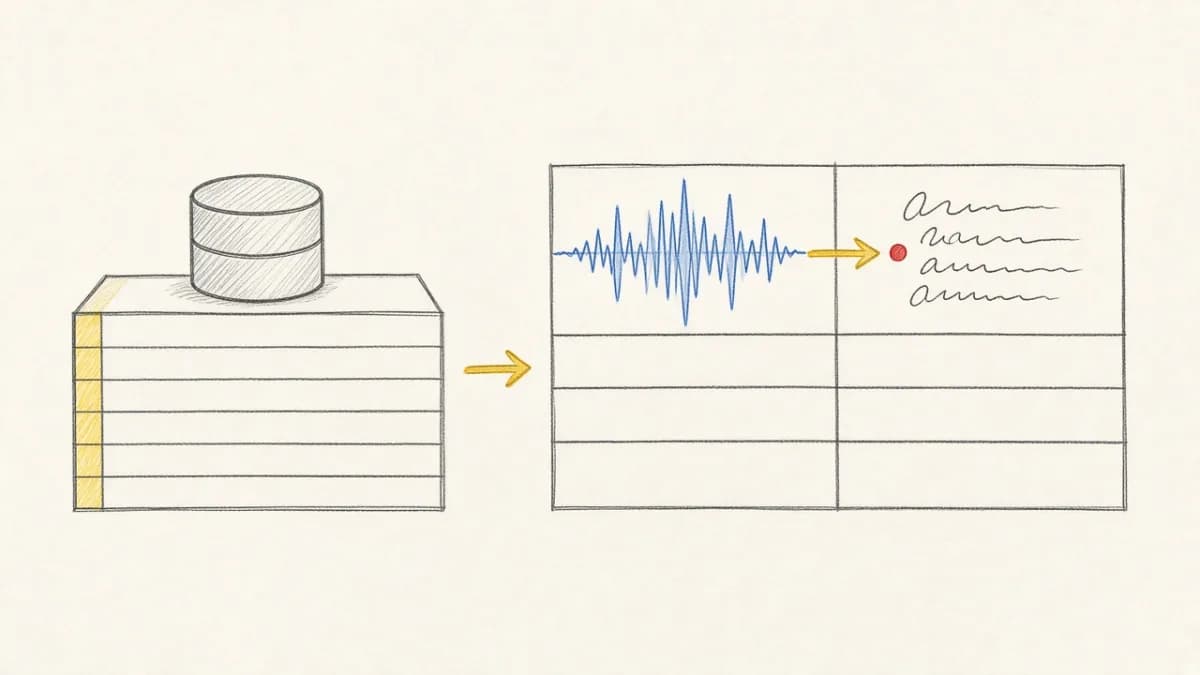
Pixeltable simplifies this entire process by providing a declarative data infrastructure specifically designed for AI workloads. Instead of manually orchestrating each step, you define the desired state, and Pixeltable handles the underlying complexity. Our full-stack RAG sample application demonstrates this power.
Code Example: Unified Data Table & Processing#
First, we define a single Pixeltable table to hold all our diverse data sources. Pixeltable natively supports various types like Documents, Videos, Audio, Images, alongside standard types.
Learn more about RAG and Indexing in Pixeltable.
Code Example: Automatic Indexing & RAG View#
Pixeltable integrates data processing and vector indexing seamlessly. We can create views to automatically chunk documents and generate embeddings, then add a vector index with a single command.
With just these declarative steps, Pixeltable provides:
- Automatic processing of ingested media (transcription, frame extraction).
- Automatic document chunking based on defined strategies.
- Automatic embedding generation for new chunks.
- An always up-to-date vector index for semantic search.
- Full data lineage tracking from source to chunk to embedding.
See an example of video and audio transcription indexing.
Key Pixeltable Features for Easier Development#
- Unified Data Management: No more juggling multiple tools or databases. Pixeltable provides a single table interface for documents, videos, audio, images, and structured data, automatically managing relationships and dependencies.
- Built-in Incremental Processing: Pixeltable intelligently tracks data and function dependencies. Changes and updates are processed incrementally, meaning only affected data triggers recomputation. This drastically saves compute time and cost compared to reprocessing entire datasets.
- Flexible LLM & Function Integration: Pixeltable integrates with popular libraries and models (OpenAI, Hugging Face, Anthropic, local models via Ollama/Llama.cpp) and allows you to easily register your own custom Python functions (UDFs).
Full-Stack Sample App Architecture#
The sample application (available on GitHub) provides a production-ready blueprint:
- Pixeltable: Handles all data ingestion, processing, embedding, indexing, and lineage tracking.
- FastAPI Backend: Provides scalable API endpoints for interacting with Pixeltable (e.g., inserting data, performing RAG queries).
- Next.js Frontend: Offers a modern, interactive UI for uploading data and chatting with the RAG system.
- Docker: Containerizes the backend and frontend for consistent environments.
- AWS CDK: Infrastructure-as-code templates for deploying the entire stack to AWS.
From Local Development to Production#
Pixeltable bridges the gap between local development and production deployment.
Getting started locally is straightforward:
Backend Setup:
Frontend Setup:
For production deployment, the provided AWS CDK templates automate the setup of:
- Amazon ECS Fargate for serverless container orchestration.
- Application Load Balancer for scalable traffic management.
- Amazon CloudWatch for logging and monitoring.
- AWS Secrets Manager for securely managing API keys and configurations.
- (Optionally) Amazon RDS or a managed vector database for Pixeltable's backend and vector index storage, although Pixeltable can run self-contained.
Real-World Applications#
This architecture pattern, centered around Pixeltable, is ideal for building robust, scalable multimodal AI systems like:
- Advanced Customer Support: Process support tickets, emails, chat logs, screen recordings, and call audio to provide agents with comprehensive context.
- Intelligent Content Management: Analyze and index large libraries of documents, images, and videos for semantic search and automated tagging.
- E-Learning Platforms: Process lecture videos, slides, and reading materials to enable students to search across all course content.
- Research & Compliance: Analyze academic papers, legal documents, financial reports, and meeting recordings for information extraction and discovery.
Getting Started#
The complete code for the full-stack RAG application is available on GitHub, including detailed setup instructions and deployment guides:
Conclusion: Build Production RAG Faster#
Building production-ready multimodal RAG applications doesn't have to be an infrastructure nightmare. By leveraging Pixeltable's declarative approach, unified data handling, incremental processing, and seamless indexing, you can focus on building valuable AI features instead of managing complex pipelines. The provided full-stack sample application gives you a clear path from local development to robust cloud deployment.
Want to learn more about building multimodal AI applications with Pixeltable?